
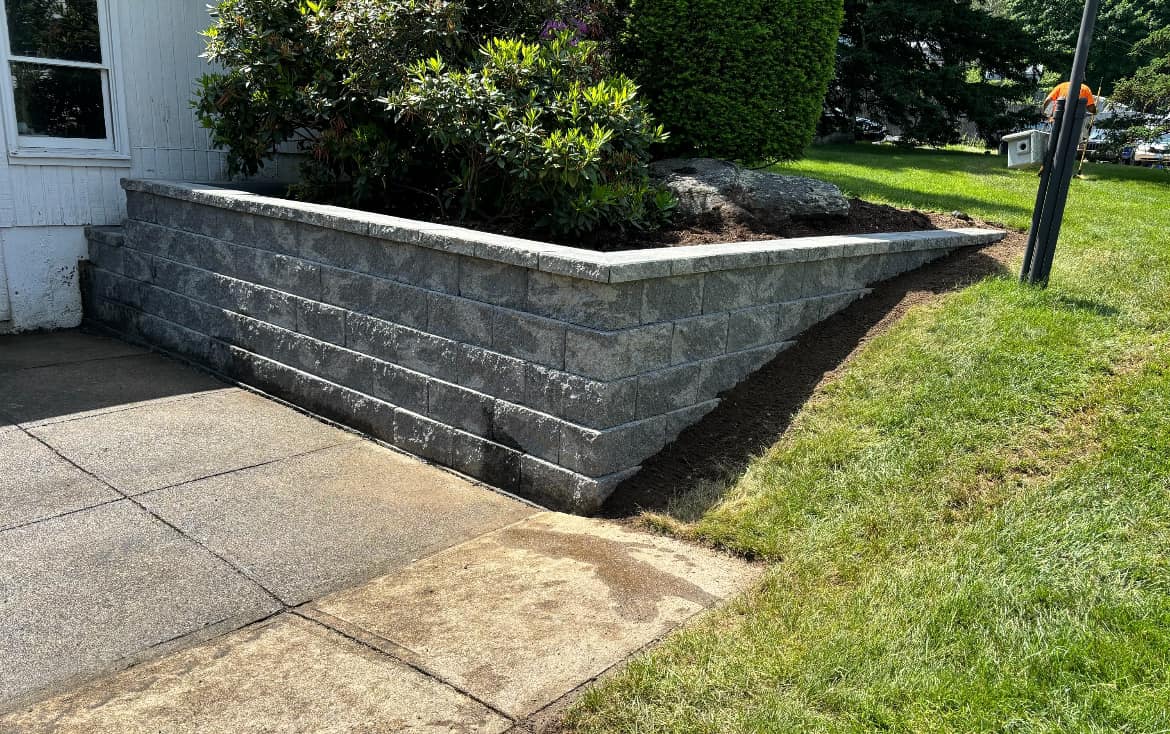
Leaning walls are almost never a block problem. They're a water problem. Here's what belongs behind every retaining wall we build.
When we get called to look at a failing wall — bulging, leaning, blocks separating at the top — the cause is almost always hydrostatic pressure from water trapped behind it, not the block itself.
What belongs behind a wall
A structural wall is a drainage system with a decorative face. Every wall we build includes:
- A compacted stone leveling pad below the first course
- The first course buried to grade for resistance
- Clean drainage stone directly behind the block
- Filter fabric separating stone from native soil
- A perforated drain pipe daylighted to a low point
- Geogrid reinforcement layered into the backfill on taller walls
Height changes everything
Low garden and seat walls are straightforward. Once you pass roughly four feet, or you're holding back a slope with a structure or driveway above it, engineering and reinforcement matter. Terracing two shorter walls is often stronger and better looking than one tall wall.
Signs your wall needs attention
Watch for blocks that no longer sit in a straight line, joints opening at the top, soil washing through the face, or standing water above the wall after rain. Caught early, a wall can often be rebuilt in sections rather than entirely.
Talk to a real hardscaper
Free estimates across Rhode Island. Call or text Kevin Soares and we'll walk your property with you.