
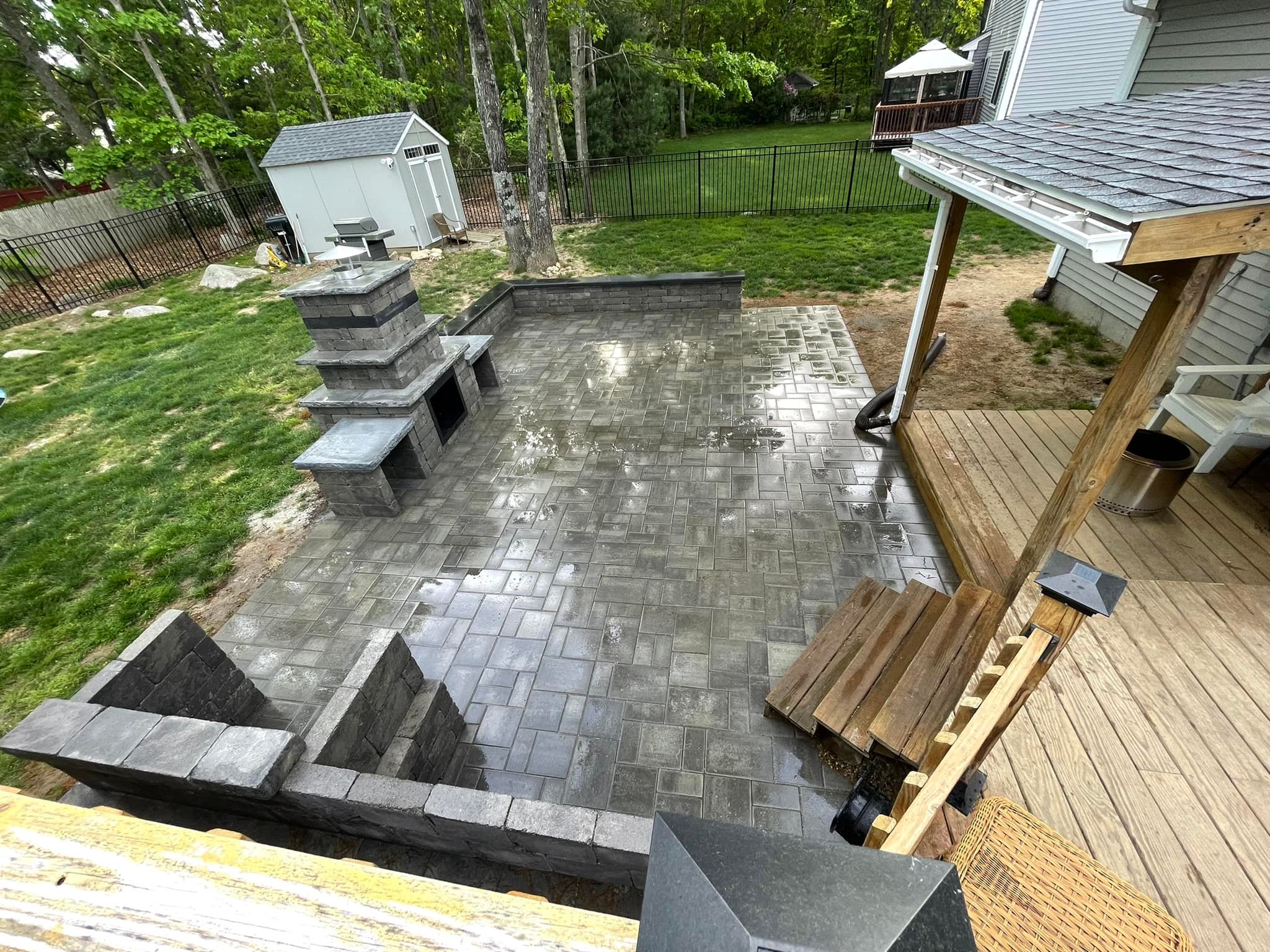
Both look great on day one. Here's how pavers and stamped concrete actually perform after a decade of Rhode Island freeze-thaw cycles.
Stamped concrete can be a beautiful, cost-effective surface. But in a climate that freezes and thaws dozens of times each winter, the difference between a poured slab and an interlocking paver system shows up fast.
Cracking
Concrete is a monolithic slab, so ground movement has to go somewhere — usually a crack. Pavers are individual units with sand joints, so the system flexes with the ground instead of fracturing.
Repairs
A cracked or stained slab typically means a patch that never matches, or a full replacement. With pavers, we lift the affected units, correct the base and reset them. Done right, the repair is invisible.
Traction and finish
Stamped concrete needs periodic resealing to keep its color, and sealed surfaces can be slick when wet. Textured pavers hold traction and keep their color because it runs through the unit.
Our recommendation
For patios, walkways and pool surrounds in Rhode Island, we recommend pavers nearly every time. Concrete still has a strong place in driveways, garage aprons and utility slabs where a large, flat, monolithic surface makes sense.
Talk to a real hardscaper
Free estimates across Rhode Island. Call or text Kevin Soares and we'll walk your property with you.